Modules over repeated forks
Business types select capabilities from a shared foundation organized around configurable boundaries.
Variation lives in modules and settings instead of a fresh codebase for every use.
W.03 / MODULAR BUSINESS SYSTEMS
One foundation. Different businesses. Deliberate boundaries.
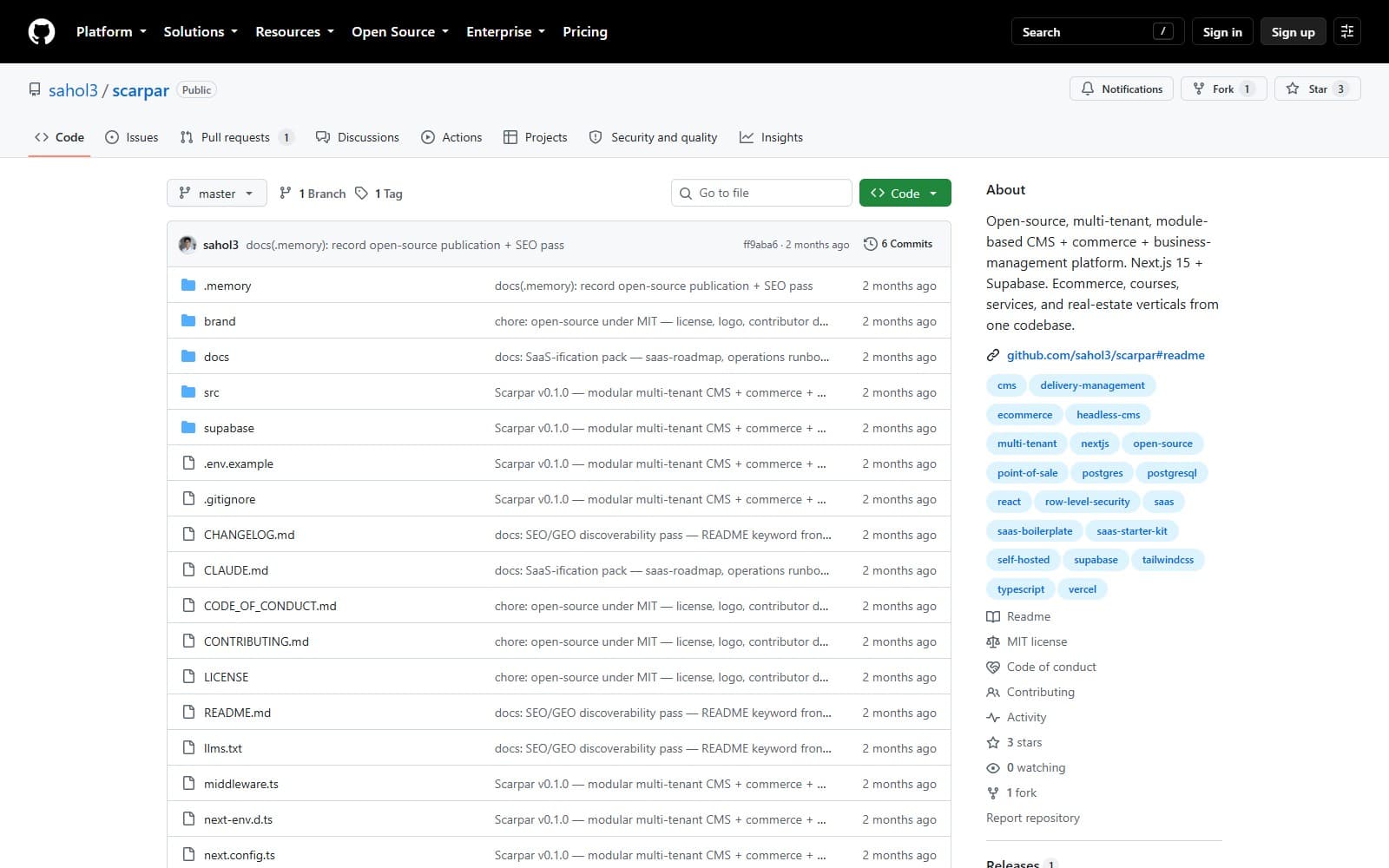
A multi-tenant core with configurable modules and vertical presets, backed by organization-scoped data and operational workflows.
Modules over repeated forks. Business types select capabilities from a shared foundation organized around configurable boundaries.
Carry tenant scope into the data. The architecture documents Postgres row-level policies alongside organization-aware application flows.
Scarpar explores how much of that foundation can be shared without forcing every business into the same operating model.
Commerce, content and operations repeat many foundations, while each business needs a different set of capabilities.
A multi-tenant core with configurable modules and vertical presets, backed by organization-scoped data and operational workflows.
Business types select capabilities from a shared foundation organized around configurable boundaries.
Variation lives in modules and settings instead of a fresh codebase for every use.
The architecture documents Postgres row-level policies alongside organization-aware application flows.
Access boundaries belong to the architecture and require their own testing.
An open-source CMS, commerce and business-management platform with modular storefront and administration flows.
Some adapters are configuration-gated. Documented access policies are not a claim of an independent security audit or production-scale validation.
Tell me what you want to make possible, where the difficulty is, and what a useful result would look like.