01
I WANTED TO SEE FURTHER.
At eleven, I was fascinated by astrophysics. My family couldn't afford a telescope, so I started learning optics from YouTube and built one myself.
FOUNDER / DEVELOPER + AI ENGINEER
SYSTEMS · AI ARCHITECTURE · PRODUCTS
02 — ORIGIN
ACQUISITION LOG
How the founder was acquired — in four entries, unpolished.
01
At eleven, I was fascinated by astrophysics. My family couldn't afford a telescope, so I started learning optics from YouTube and built one myself.
02
Building and dissecting things was the attraction from the beginning. I wanted to understand the underlying logic — how the parts could make something more than themselves.
03
Now that curiosity reaches into software, AI, systems, ESP32s and sensors. The materials change. The urge to understand and make things stays.
04
The building itself is the point now. Jack of all trades, master of a few — shipping systems that outlive the reasons they were started.
03 — ABOUT · THE FOUNDER
I'm Sahol Mohammad — founder of Kronx, working on systems and AI at Elite Heights. I build systems: software, AI architecture, products that ship. And I research the question most of the industry skips — whether AI actually helps the people it claims to help. Students first.
I think in systems before mechanisms — the why gets written before the how. Speed and rigor aren't rivals here; reversibility decides. If a decision can be undone, move now. If it can't, slow down and get it right. That one rule runs everything: fleets of AI agents on raw infrastructure, PostgreSQL on metal I manage myself, and a delivery standard of weeks, not years — without ever shipping a toy.
The operating philosophy is connection but detachment: close enough to move fast, detached enough to stay clear. Jack of all trades, master of a few — and honest about which is which. The work is the argument. Everything else on this page is just the museum built around it.
THE PERSON BEHIND THE WORK ↗TOSHINELIKEASTAR,YOUGOTTABURNLIKEONE.
Standing out is paid for in energy. I budget for the burn instead of pretending it's free.
DREAMSAIN'TWHATYOUSEEINYOURSLEEP—THEY'REWHATDON'TLETYOUSLEEP.
The filter for what gets built: if it doesn't keep me up, it doesn't get my hands.
COMFORTNEVERCREATEDALEGACY.
Comfort is a fine reward and a terrible strategy. I treat it as the former, never the latter.
SELECTED WORK
Open a project. Separate its interface, its structure and the reason it exists.
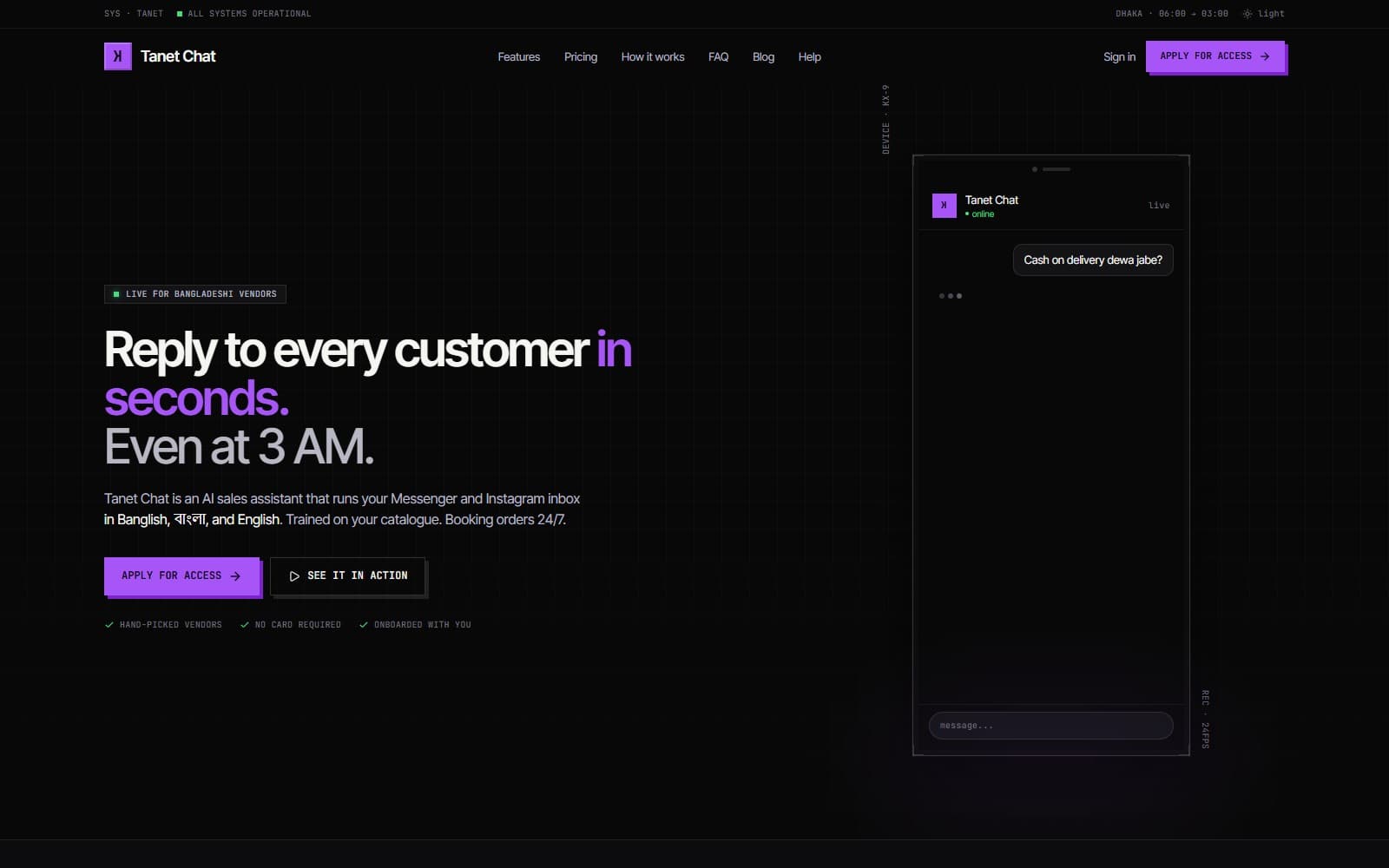
Connect conversations to the shop's catalog, keep negotiation within the owner's limits, and turn confirmed details into a structured order workflow.
Keep the seller in control. A useful sales assistant needs constraints as well as language. Prices and negotiation boundaries belong to the shop.
Start with the actual conversation. Bangla and Banglish are central to the product's intended conversation flow.
05·B / THE EVIDENCE
An idea leaves the room.
These are the places it became.
06 — VENTURES · THE PERMANENT COLLECTION
07 — PROOF · WHAT’S SHIPPED
08 — WORKSHOP · HOW IT RUNS
DIVISION 4 / 4
09 — THE DIFFERENCE
D.01 — THE DESK · WHAT YOU CAN COMMISSION
Three ways to put me on something. Each one states what it is, what leaves with you, and — on the same card — when you should not buy it.
Everything. Source, domain, database, deploy keys. Nothing I run is a hostage.
you want a design mockup, a pitch deck, or a thing that looks finished and isn't. No toys ship.
The whole machine and the reasoning behind it. Intent survives the handoff.
the requirements are still being discovered. Philosophy before mechanism — if the why isn't written, the how is guesswork.
Your keys stay yours. Cancel and everything keeps running without me.
you need someone on a rota answering tickets. This is engineering leverage, not a helpdesk.
Priced on scope, and quoted inside the first thirty minutes — not after three meetings and a proposal. If the budget and the scope don't meet, you'll hear that on the call, from me, while it still costs you nothing.
D.02 — THE DESK · THE WEEK
Said four times elsewhere on this page and never shown. Here it is, with the column nobody else prints: what the week costs you.
That is the whole ask on your side. The reason the week works is that it doesn't run on your calendar.
D.03 — THE DESK · THE HOSTILE QUESTIONS
Asked the way you'd ask them if I weren't in the room.
No. A template is something that already exists being recoloured. The week works by cutting, not by reusing — day one removes everything that isn’t load-bearing, which is the only reason day seven arrives. Open the collection above: nothing in it shares a layout with anything else in it.
One person, plus fleets of AI agents running on infrastructure I manage by hand. That’s the leverage, and it’s written down in the workshop room rather than implied. What you don’t get is a project manager relaying your words to a junior who has never spoken to you.
Source in your repository. Infrastructure in your name. Deploy in one documented command. Nothing I run is a hostage — that’s a design constraint, not a courtesy. If you want to test it, ask for every key on day seven and watch nothing break.
Then you want the build or the fleet, not the week. I inherit other people’s decisions without editorialising and I read logs before I read opinions. The one thing I won’t do is quietly rewrite something that already works so that it looks like mine.
Because I don’t know what you’re asking for yet, and a number invented before the scope is a number that gets revised upward later. What I will commit to: a real quote inside the first thirty minutes, from me, on the call. If your budget and the scope don’t meet, you’ll hear that then — while it has cost you nothing.
You’ll have seen it on day three, on a real URL, with real data — not at week six in a slide. Reversibility governs speed: everything ships behind a flag and rolls back in one move, so you see it early enough that changing it is cheap. That is the entire reason the rule exists.
Because each one links to the thing it came from, and because the rating shown above is 4.8, not 5. The projects with no sourced outcome display no outcome — a title and nothing else, which looks worse and is true. If a claim on this page can’t be checked, it isn’t on this page.
Anything still unanswered is a better use of the thirty minutes than anything answered above.
ASK IT DIRECTLY — 30 MIN10 — RESEARCH · THE STUDY
Capability keeps outrunning evidence. This inquiry is mine — not a venture's. I build the systems, then ask the uncomfortable question: did anyone actually learn? For the students and the people it claims to help. The honest answer is being built, measured, and rebuilt.
STATUS: ONGOING — PERSONAL RESEARCH
11 — THE LIBRARY · WHAT I READ OVER COFFEE
PULL A BOOK FROM THE SHELF
1984 — The manual for watching the watchmen.
NOW — BUILDING INSTRUMENTS, SOFTWARE & SYSTEMS · SEPTEMBER 2026
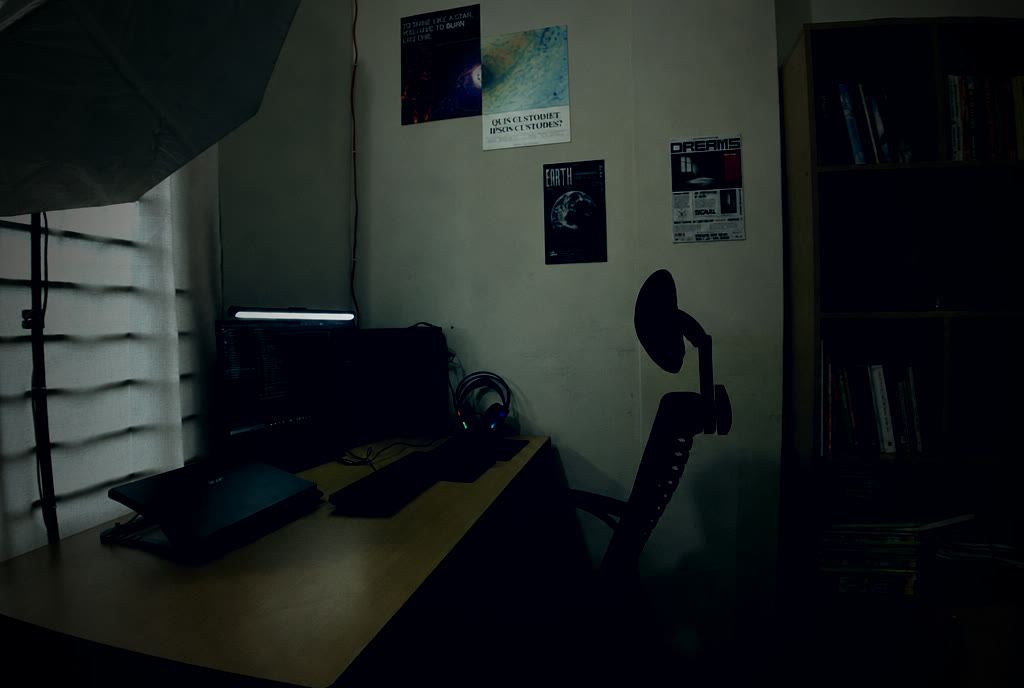
14 — THE WORKSPACE · STATE A: THE VOID
This is the actual room, photographed — lid closed, chair empty, the posters holding the wall. Everything the museum just showed you was built between that chair and those two screens. The grain gives way where you look.
S / 01 — THE VISITOR RECORD
Your chapters, your time, your way through. Printed onto something you can pull out of the machine.
PRESS PRINT · PULL DOWN TO TEARTICKETS — KEEP YOUR STUB
SAHOL — THE MUSEUM
ADMIT ONE · NO RE-ENTRY REQUIRED
STAMPED 03:25 +06
the museum remembers you now
THE MUSEUM ENDS. THE BUILDING DOES NOT.
CHAPTER I ENDS AT THIS DESK
CHAPTER 1 OF 3 — 2 FLOORS BELOW THIS ONE
DESCEND — CH.II: THE ACCELERATIONBelow the museum floor: the sketchbook. The speed before the polish, the notes before the systems — how the mind actually moves.
12 — ELSEWHERE · FIND ME
THE SIGNALS I KEEP LIT